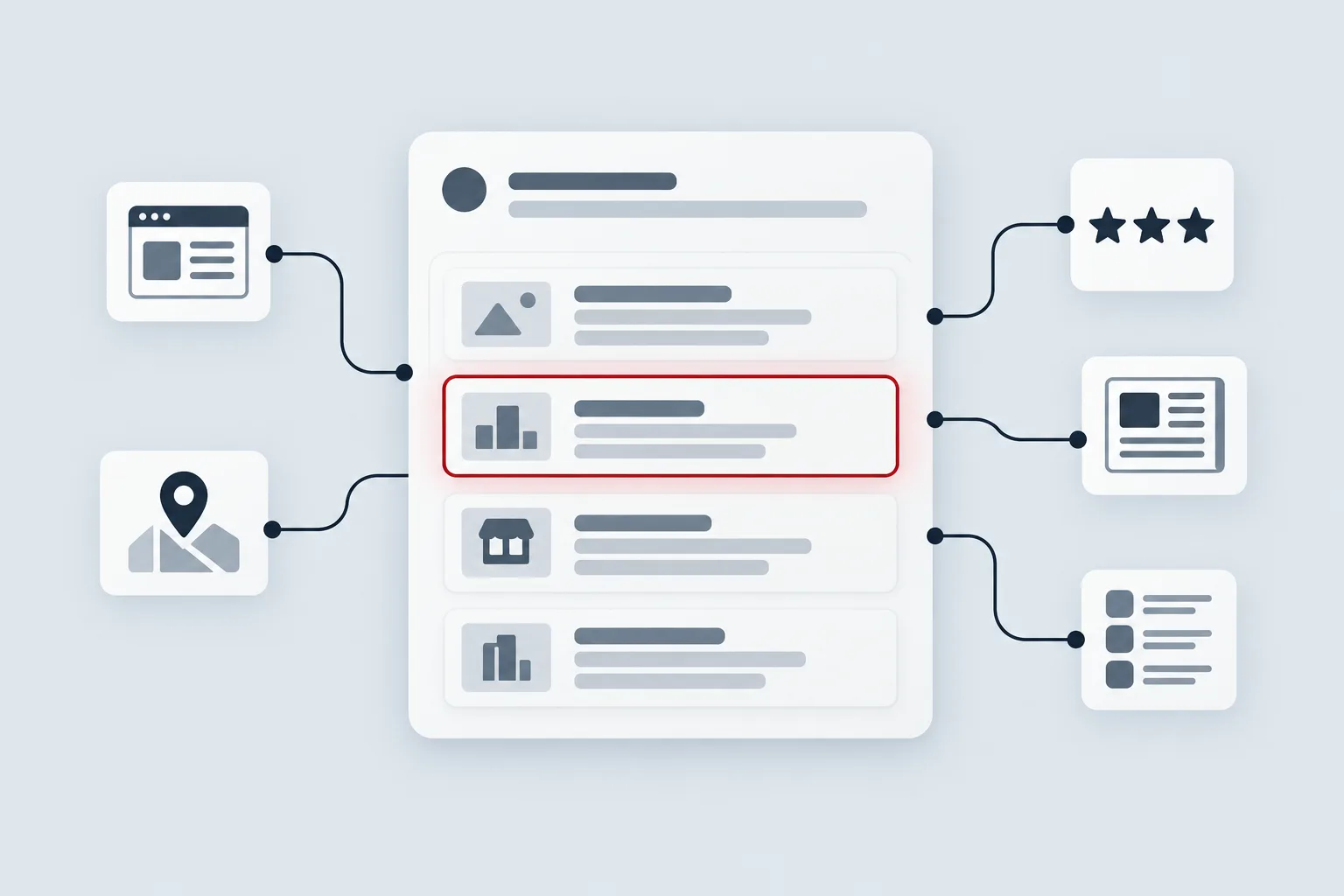
SEO, GEO and AEO: what each one is and which one your business needs
SEO, GEO and AEO sound like three different services, but they share 80% of the work. Here is what each one is and which to prioritize for your type of business.
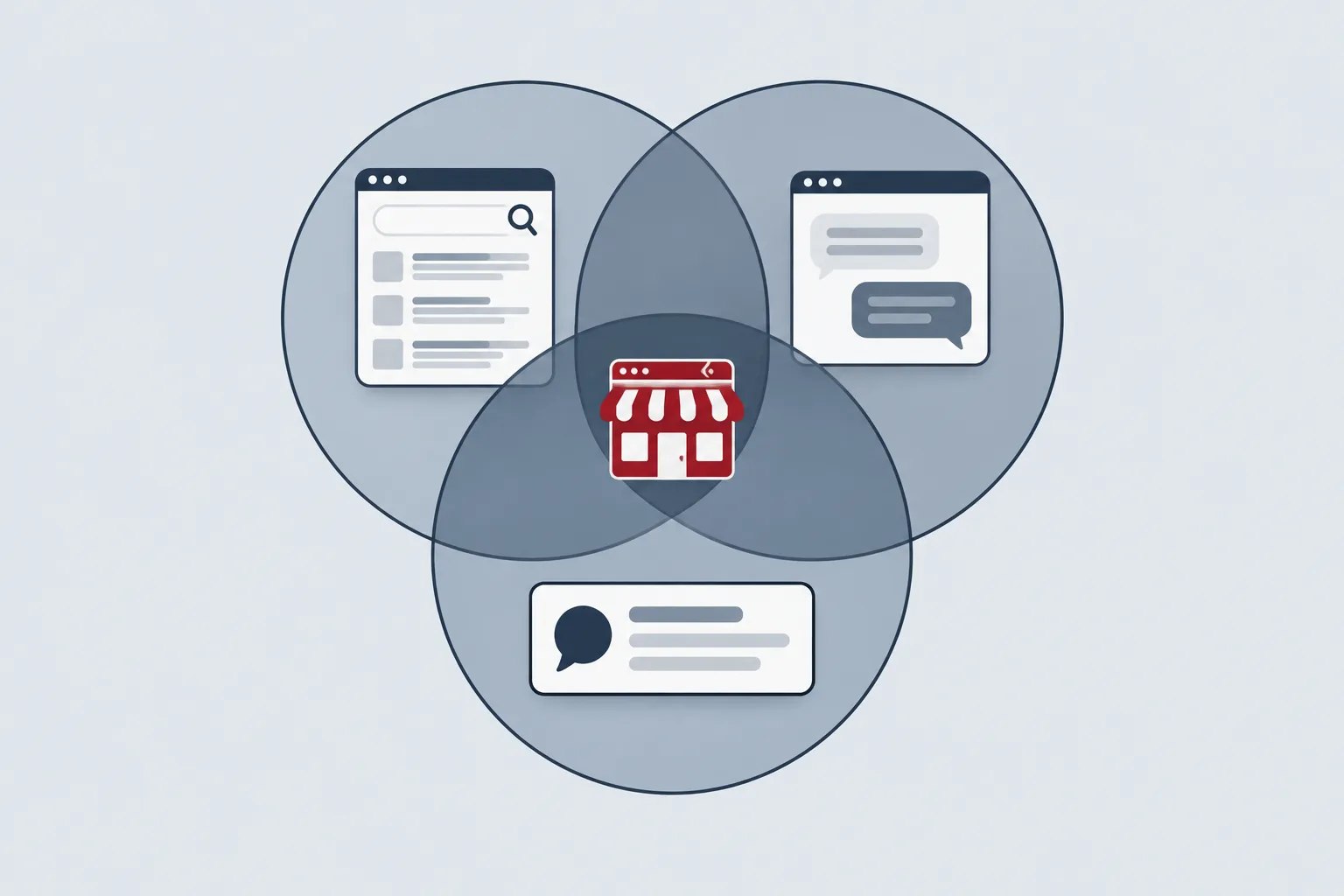
SEO is getting your website to show up when someone searches Google for what you sell. AEO (Answer Engine Optimization) is getting your website to be the answer to a question: the featured snippet, the "People also ask" box or what a voice assistant reads out. GEO (Generative Engine Optimization) is getting ChatGPT, Gemini, Perplexity and Google's AI answers to mention and recommend your business. Most businesses need all three, because they share most of the work; what changes is where it makes sense to start.
The acronyms are confusing because they sound like three different services. In practice they are three places where a customer can find you, and the groundwork for showing up in any of them is the same. This guide explains what each one is, what they share, how they differ and how to decide what to prioritize for your type of business.
The three acronyms in one table
| Term | What it aims for, in plain words | Where you see it |
|---|---|---|
| SEO | Your website shows up when someone searches Google for what you sell | Regular Google results and Google Maps |
| AEO | Your website is the one that answers the question | The top of Google (featured snippets, "People also ask") and voice assistants |
| GEO | AI tools mention and recommend your business | Answers from ChatGPT, Gemini, Perplexity and Google's AI answers |
SEO: show up when people search
SEO (Search Engine Optimization) is the best known of the three and it is still the foundation. In Guatemala, where we are based, Google handles 94% of searches, according to StatCounter. If someone types "[your service] in [area]" and you are not on the first page or on the map, that customer goes to someone else.
SEO works on three things:
- The technical side: Google can read, crawl and index your site without errors. Indexing means Google stores the page in its database and can show it.
- Content: there is a clear page for each thing you sell and for each important question your customers ask.
- Authority: trustworthy sites link to you or mention you, and you have reviews.
It is measured with hard numbers: clicks, impressions and positions in Google Search Console, and conversions (WhatsApp, calls, forms) in Google Analytics.
AEO: be the answer
AEO was born when Google started answering questions directly on the results page. When someone searches "how long does [some process] take?", Google often shows a paragraph pulled from a website, right at the top. That paragraph is a featured snippet. Below it there is usually a list of related questions that expand to show an answer.
To win those spots, content has to be written in a particular way:
- Answer first. One or two sentences that fully answer the question, then the explanation.
- Real questions as subheadings. The same ones your customers ask you on WhatsApp or in the store.
- Formats that are easy to extract: step lists, tables, short definitions.
AEO is, to a large extent, well-written SEO. That is why many agencies no longer sell it on its own.
GEO: get AI to recommend you
GEO is the newest. When someone asks ChatGPT "which [your industry] company do you recommend in my city?", the answer is not a list of ten links: it is three or four names. GEO aims to get yours among them.
It matters because people already use these tools. According to StatCounter, ChatGPT accounts for 64.6% of AI chatbot usage in Guatemala and Gemini for 30%. Google also shows AI answers in Spanish: AI Overviews (the AI-generated summaries at the top of the results) since October 2024 and AI Mode since September 2025.
What weighs the most in GEO:
- AI companies' crawlers can get into your site.
- Your information is clear and consistent everywhere: website, Google, social media and directories.
- Other sites talk about you: comparison articles, directories, media, reviews. AI models distrust what a business says about itself.
We walk through it step by step in our guide on how to show up in ChatGPT answers.
What they share: 80% of the work is the same
This is the key point: they are not three projects. There is a foundation that serves all three at once:
- A technically sound website. If Google cannot index a page, it does not show up in results, it cannot be a featured snippet and Google's AI answers cannot cite it either. ChatGPT, when it searches the web, also relies on search engine indexes.
- Content that answers real questions. One page per service, with prices or ranges, areas served, timelines and FAQs. That same content ranks on Google, wins snippets and is what AI cites.
- A business that is mentioned on other trustworthy sites. Links, reviews, directories and media raise your authority on Google and give AI reasons to recommend you.
This is not just our opinion. In its guide to generative AI features in Search, Google says that, from its point of view, optimizing for generative AI search "is still SEO", and that its AI features rely on the same ranking and quality systems as Search.
What does change between them
The remaining 20% is different, mostly in how it is measured and in what matters most:
| SEO | AEO | GEO | |
|---|---|---|---|
| Goal | Get found on Google | Be the direct answer | Get AI to mention and recommend you |
| Where you see it | Results and Google Maps | Featured snippets, "People also ask", voice | ChatGPT, Gemini, Perplexity, Google's AI answers |
| What matters most | Technical health, content and links | Format: short, direct answers | Mentions on other sites and consistent information |
| How it is measured | Clicks, positions and conversions in Search Console and Analytics | Which questions you win and with which page | In how many test questions your brand appears and which sources AI cites |
| How fast it moves | Months | Weeks to months, if you already rank | Weeks for what AI finds when it searches; slower for what the model "knows by heart" |
| Who controls the outcome | Nobody can guarantee it | Nobody can guarantee it | Nobody can guarantee it |
The last row is intentional. No serious provider can guarantee you a position on Google or that ChatGPT will recommend you by a certain date.
How to decide where to start
The technical foundation always comes first: there is no point writing content for a website Google cannot index. After that, the order depends on how your customers buy.
Local business (clinic, auto shop, restaurant, hardware store, law office)
Your customer searches "near me" or "[service] in [area]", often on a phone and in a hurry.
- Local SEO first: a complete Google Business Profile with categories, hours, photos and reviews, and the same name, address and phone number on your website, on Google, on social media and in directories.
- Then AEO: your customers' frequent questions answered on your website ("are you open on Saturdays?", "how much does [service] cost?", "do you take insurance?").
- GEO as a result: for local questions, Google's AI answers lean heavily on the Business Profile and reviews. If you did the first two steps well, you have covered most of the ground.
B2B company (services for other businesses, manufacturing, distribution)
Your customer does research before asking for a quote, compares suppliers and often asks ChatGPT to build a shortlist.
- Content that answers and compares: pages per service, case studies (even anonymous ones), price ranges or what the price depends on, lead times, certifications.
- GEO matters more than for other businesses: questions like "which [product] suppliers are there in [country]?" are increasingly asked to AI. Being listed in your industry's directories, chambers of commerce and on partners' and suppliers' sites is key.
- SEO for buying searches: few searches, but each one is worth a lot. You do not need thousands of visits; you need the right ones.
Online store
Your customer searches for specific products, compares prices and wants to know if you ship to their area.
- Technical and category SEO first: in stores with many pages, technical errors (duplicate products, filters that generate thousands of URLs, pages that are not indexed) are the ones that cost the most sales.
- Complete product pages: price, availability, shipping, warranty and product structured data (code that tells Google what each thing is).
- AEO and GEO for decision questions: "which [product] is right for [use]?", buying guides and comparisons with your own data.
Why we treat it as a single service at Zyncro
We do not sell SEO, AEO and GEO separately. We treat them as one service with three fronts, because splitting them would mean charging three times for the same foundation. What we do is measure the three separately: positions and clicks on Google, questions where your website is the answer, and in how many test questions AI mentions you. That shows which front is moving and which one needs more work.
Frequently asked questions
What are GEO and AEO, in a nutshell?
AEO is getting your website to be the direct answer to a question on Google, such as the featured snippet or a voice assistant's reply. GEO is getting AI tools like ChatGPT, Gemini or Google's AI answers to mention and recommend your business when someone asks them for options.
Will GEO replace SEO?
Not in the short term. Google still handles the vast majority of searches in Guatemala, and its AI answers rely on its own index. ChatGPT also uses search engine indexes when it searches the web. Good SEO is the foundation of GEO, not its competitor, so the work you put into one carries over.
Do I need to hire all three separately?
No. They share most of the work: a technically sound website, content that answers real questions and mentions on other sites. The sensible approach is one plan that covers all three and measures each one separately, so you know what is working and where to put more effort.
Which one delivers results faster?
It depends on where you start. If your website already ranks on Google, AEO and what AI finds when it searches the web can move within weeks. If you are starting from scratch, the technical and content groundwork takes months before any of the three shows clear results.