How to show up in ChatGPT's answers
ChatGPT recommends businesses it can find, understand and verify on other sites. Here is how it works and the 7 steps to get your business into its answers.
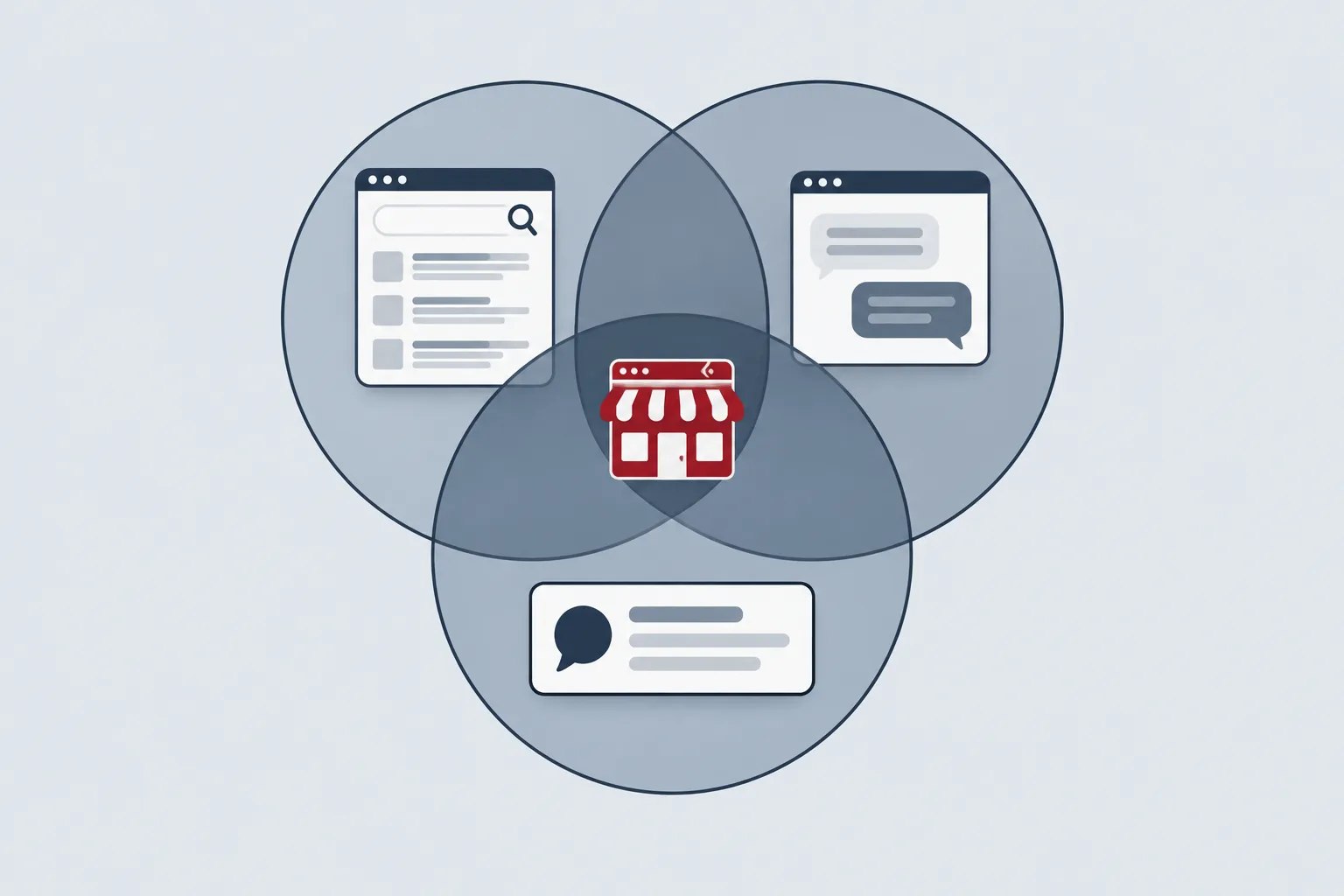
To show up in ChatGPT's answers, your business has to meet three conditions: ChatGPT must be able to read your website, it must understand clearly what you sell, where and to whom, and other trustworthy sites must talk about you. There is no button or payment that guarantees it. It is the same groundwork as SEO, with a few adjustments that very few businesses in Latin America are making yet. This work is called GEO (Generative Engine Optimization).
Why start now: in Guatemala, where we are based, ChatGPT holds 64.6% of AI chatbot usage, followed by Gemini with 30%, according to StatCounter. Google has also shown AI answers in Spanish since 2024. When someone asks "which [your industry] company do you recommend in my city?", the answer is no longer a list of ten links: it is three or four names. The question is whether yours is one of them.
How ChatGPT decides who to mention
ChatGPT builds its answers from two sources:
- What the model learned during training. This is what it "knows by heart" about brands, products and companies. It only updates when a new version of the model comes out, so it changes slowly.
- What it searches on the web at that moment. When the question calls for it (recommendations, prices, something local or recent), ChatGPT searches the web, reads a few pages and cites its sources. This part can move in a matter of weeks.
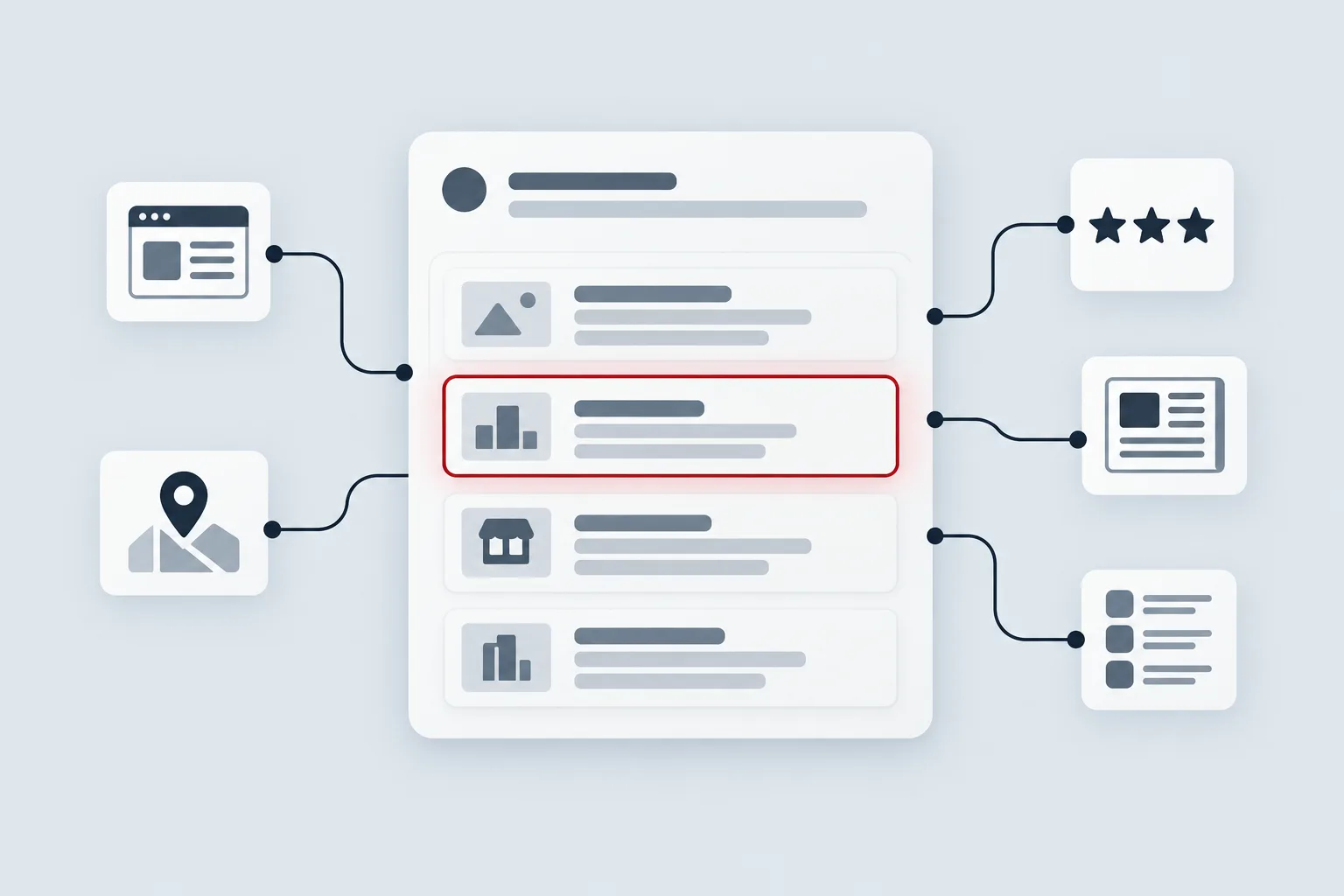
In both cases, the business that wins is the one that appears clearly and consistently in many places: its own website, Google, directories, reviews, media and comparison articles. If your website says one thing, your Google profile says another and nobody else mentions you, the model has nothing to recommend you with.
Step 1: run the test before you change anything
Before changing anything, measure where you stand. Write 15 to 30 questions a real customer would ask and run them in ChatGPT, Gemini and Google (in AI Mode). For example:
- What is the best [industry] company in [city]?
- Where can I [buy or hire what you sell] in [area]?
- How much does [your service] cost in [country]?
- [Your company] vs. [your competitor], which one should I choose?
For each question, write down three things: does your business appear? who appears instead? and which pages does it cite as sources? That table is your baseline. The third column is the most valuable one, because it tells you exactly which sites you need to be on.
Step 2: let the AI bots in
It sounds obvious, but it is the most common mistake and it is invisible. Many websites block OpenAI's and other AI companies' crawlers without knowing it, either in the robots.txt file or in their provider's firewall (Cloudflare, for example, offers a setting to block AI bots).
It happened to us. While auditing our own website, we found that Cloudflare was blocking GPTBot, the crawler OpenAI uses to collect content for training its models. Our robots.txt was clean: the block came from a firewall setting. We fixed it the same day.
OpenAI uses three different crawlers, and it helps to know what each one does:
| Crawler | Why it visits your site |
|---|---|
| OAI-SearchBot | So your site can appear and be cited in ChatGPT's search results |
| ChatGPT-User | When a user asks ChatGPT to visit a page right now |
| GPTBot | To train future models |
If you want to appear in answers, the first two must be allowed at the very least. Allowing GPTBot is a business decision: if you block it, future models will know less about you.
Step 3: get found on Google and Bing
When ChatGPT searches the web, it relies on search engine indexes, and Bing is one of the most important ones. If your site is not properly indexed, ChatGPT will not find it either.
- Register your site in Google Search Console and Bing Webmaster Tools (you can import it from Search Console in a few minutes) and submit your
sitemap.xml. - Check that your important pages are not excluded by technical errors: wrong canonical tags, redirects, pages that need JavaScript to show their content.
- If you serve customers at a physical location or in a service area, complete your Google Business Profile. Google's AI answers lean on it heavily for local questions.
In Guatemala, Google has 94% of searches. Bing has few direct users, but it matters because of what it feeds into ChatGPT.
Step 4: one page for each thing you sell
A very common mistake: the business has a single page that talks about everything. For ChatGPT (and for Google), it is very hard to recommend someone for a service that only shows up as a paragraph on the home page.
Every important product or service needs its own page, and every page should answer, without detours:
- What it is and who it is for.
- Where you offer it (city, areas, whether you ship nationwide).
- How much it costs, or at least a range or what the price depends on.
- Why you and not someone else: years in business, cases, certifications, guarantees.
- How to hire you: WhatsApp, phone, form.
Write the answer first and the explanation after. AI models tend to cite sentences that fully answer a question in two or three lines. That is why a visible FAQ section on the page, with 40 to 60-word answers, is still one of the most useful things you can add: it helps your readers and gives AI answers that are ready to quote.
Step 5: say clearly who you are
ChatGPT needs to be sure that "López Distributors" on your website, on Google Maps, on Facebook and in a directory is the same company. Help it:
- Same name, address and phone number everywhere, written the same way.
- An "About us" page with real people: names, photos, experience. Search engines and AI models give weight to who is behind a business.
- Structured data (schema) on your site: an invisible block of code that tells machines "this is a company, this is its name, it is located here, these are its social profiles". The most useful types are
OrganizationorLocalBusiness, andServiceorProduct. - Visible update dates on your content, especially if it mentions prices or figures that change.
Step 6: get others to talk about you
This is the slowest step and the one that weighs the most. A business that only mentions itself is hard to recommend. Go back to the "sources" column from your test in step 1: those are the sites ChatGPT checks for your industry. They are usually:
- Directories and comparison articles in your industry ("the 10 best dental clinics in [city]").
- Reviews on Google and on your industry's platforms.
- Local media, chambers of commerce and associations.
- Suppliers and partners that list you as a client or distributor.
- Forums, groups and videos where people ask for recommendations.
This is not about buying links or making up reviews. It is about being present, with the same information, in the places where your industry is already being discussed. Asking every happy customer for a Google review is one of the most profitable things you can do.
Step 7: publish something only you can say
AI models cite sources that add something you cannot find elsewhere: data, real prices, comparisons, first-hand experience. A generic "5 tips for…" article competes with thousands just like it. In contrast, "How much an automatic transmission repair costs in Guatemala in 2026, based on 300 repairs we did" is something ChatGPT has good reasons to cite.
You have data nobody else has: your prices, your turnaround times, the questions your customers ask, your cases. Turning that into content is the most direct way to become a source.
What does not work
- Repeating keywords or stuffing pages with text "for the AI". Models read like people do, and filler pushes them away.
- Expecting results in a week. What ChatGPT finds when it searches can change in weeks, but what it "knows by heart" depends on new model versions.
- Hiring someone who guarantees you will appear. Nobody controls what ChatGPT answers. Anyone who promises it by a certain date is not being honest.
- Relying on a single trick, such as an
llms.txtfile. It can be a complement, but today there is no solid evidence that ChatGPT uses it to decide who to recommend.
How to know if it is working
Repeat the test from step 1 every month, with the same questions and the same tools, and compare:
- In how many questions your business appears (for example, 3 out of 20 in month 1 and 8 out of 20 in month 3).
- Where it appears within the answer and whether it describes you correctly.
- Which sources ChatGPT cites and whether any of them are yours.
In Google Analytics 4 you can also see visits coming from chatgpt.com in the traffic acquisition report. They are still few for most websites, but they tend to arrive with the decision almost made.
Frequently asked questions
Can you pay to appear in ChatGPT?
There is no way to pay for ChatGPT to mention you in its recommendations. What you can do is work on the signals it uses to decide: a website it can read, clear information about your business and mentions on trustworthy sites.
How long does it take for my business to appear in ChatGPT?
It depends on where you start. If your website already ranks well on Google, changes can show up in ChatGPT's searches within a few weeks. If you are starting from scratch, plan for three to six months of steady work on content and mentions.
Is GEO the same as SEO?
No, but they share most of the work. SEO aims to get you into Google's results. GEO aims to get AI models to mention and cite you. A technically sound website, with useful content and mentions on other sites, serves both.
Does the same apply to Gemini and Google's AI answers?
Mostly, yes. Gemini and Google's AI answers rely on Google's index, so SEO matters even more there. The steps in this guide apply to every tool; what changes is where it makes sense to measure.
Is my business too small for this?
No. For local questions ("where can I find [service] in [town]?") few businesses compete and the available information is usually thin. A small business with a clear website, a complete Google profile and good reviews can appear ahead of a large one that has not done the work.